Water heater replacement vs repair in Detroit
A tank twelve years old with a rusted seam is a replacement. A tank five years old with a dead thermocouple is a part. Here are the published numbers on both, and the efficiency figures that decide whether anyone helps pay.
A referral service for Detroit homeowners. An automated assistant answers; calls are recorded.
Send your detailsSee published cost ranges
Water on the floor right now? Start here →
Typical cost: Repair $228 – $1,017; a tank replaced and installed $882 – $1,826, average $1,348; a tankless installed $1,400 – $3,900 — published national ranges (Angi repair · Angi installation)
- Cost to call
- Nothing
- Answered by
- Automated assistant
- Hours
- Any hour
The decision
Age and where the water is coming from decide it.
Repair
A part failed and the tank is sound: a thermocouple, a gas valve, an element, a thermostat, a dip tube, an anode rod. Published national figure for replacing one part: $100 – $350 (HomeGuide); for the repair as a whole, $228 – $1,017 (Angi, updated August 2026).
Water from the discharge pipe rather than the tank is the relief valve doing its job, not a failed heater (which is which).
Replace
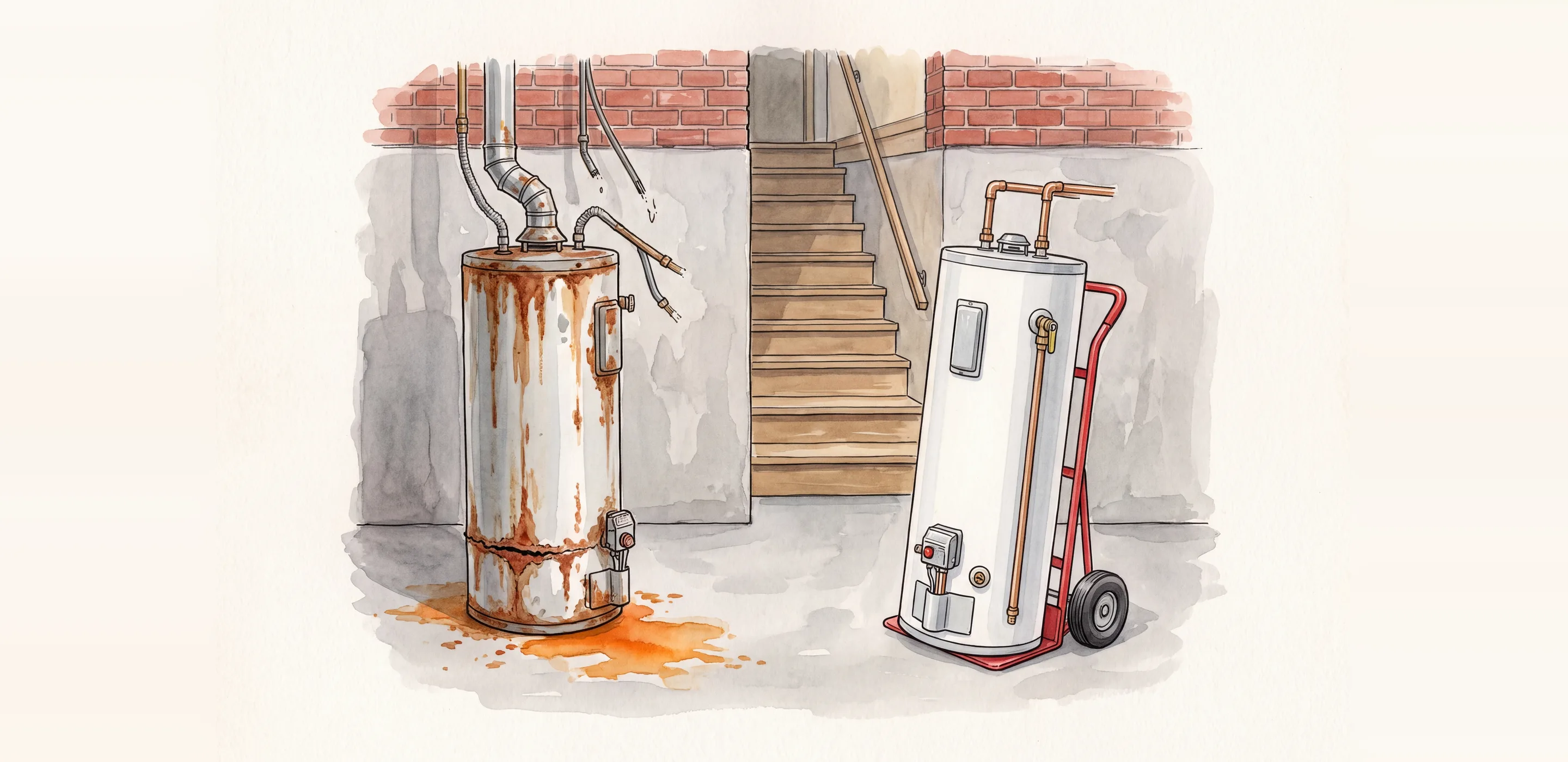
The tank itself is leaking, or it is at the end of its life. The federal energy office’s guide puts storage water heaters at 10–15 years (the guide), and HomeGuide says a leaking tank typically means replacing the heater (HomeGuide).
Published national figure: a tank replaced and installed $882 – $1,826, average $1,348; labor alone $150 – $450 (Angi, updated July 2026).
Both ranges are national. One Metro Detroit contractor posts $150 – $600 for a repair (a Metro Detroit contractor’s posted range, September 2026).
What Detroit’s water does to a tank
The water department publishes a mineral table every year. In the 2025 one, Detroit tap water measured 107 ppm total hardness on average, 96 at its softest and 142 at its hardest (the 2025 report). The federal water survey classes 61–120 as moderately hard and 121–180 as hard (the survey), so on average Detroit sits in the moderate band, and at its worst it crosses into the hard one.
That is a sediment story, not a scare story. Minerals settle at the bottom of a tank, and the manufacturers say what it does: sediment acts like insulation at the bottom of the tank, forcing the system to run longer heating cycles and increasing energy usage (Rheem). The first warning sign Rheem lists is a rumbling or popping noise from the tank.
So the maintenance interval is not the default one. A. O. Smith: most tank heaters need flushing at least once a year, and if you live in a hard water area you may need to flush more often; inspect the anode rod once a year, and have the relief valve checked yearly by you and every five years by a professional (A. O. Smith). Rheem is more specific: once a year normally, every 6 months with hard water (Rheem). DTE says annual flushing removes the sediment that builds up (DTE). Published national cost of a flush: $75 – $250 (HomeGuide).
Before you pick a unit
Two efficiency numbers decide whether anyone helps pay
- DTE’s instant discount. DTE takes it off at the participating contractor or at the store, on a gas tank or tankless unit rated 0.81 or better and an electric heat pump unit rated 2.2 or better; the rating is the UEF, the federal efficiency measure for water heaters (DTE). DTE publishes no dollar amount; ask the contractor what comes off. DTE also says the funds are first come, first served.
- A loan program the state backs. Its lenders lend from $1,000 up to between $30,000 and $100,000, depending on the lender, at rates they publish as low as 6.24% to 6.99%, over terms up to 180 months, and it names water heaters including heat pumps as an eligible improvement (the program). Its own list sets the floors by type: a gas storage tank at 0.67, gas condensing at 0.80, gas tankless at 0.82, electric at 0.93, and an electric heat pump at 2.0 (the eligible improvements list, updated April 2026). You apply through one of the program’s own contractors.
- Michigan’s emergency relief. For a homeowner who qualifies, it covers repair or replacement of a water heater that has stopped working, up to $1,500 in a lifetime, applied for on the state’s online portal (the program · the portal). All of the money, in one place.
What moves the price
- Tank or tankless. A tankless unit installed is published at $1,400 – $3,900 against $882 – $1,826 for a tank, and its labor alone at $600 – $1,900 against $150 – $450 (Angi). It also lasts longer on the federal guide’s figures. What tankless changes in a Detroit house.
- The venting. Replacing what is there is published at $100 – $600; a new run at $500 – $1,500 (HomeGuide, national).
- The gas connection. On Detroit’s fee schedule the gas piping is a mechanical line with its own permit fee (the city’s fee schedule). Ask whether the contractor holds the mechanical license as well as the plumbing one. The fee lines and who pulls what.
- The permit. One vendor estimates the permit nationally at $25 – $300 (Angi). Detroit prints its own lines, and they are not that number — what the city’s schedule actually says.