Leaking water heater in Detroit?
Close the valve on the heater’s own cold water pipe first. The state plumbing code requires one there. If that will not hold it, close the main shutoff. Then call us: your details go to one water heater contractor who serves Detroit.
A referral service for Detroit homeowners. An automated assistant answers; calls are recorded.
- Cost to call
- Nothing
- Answered by
- Automated assistant
- Hours
- Any hour
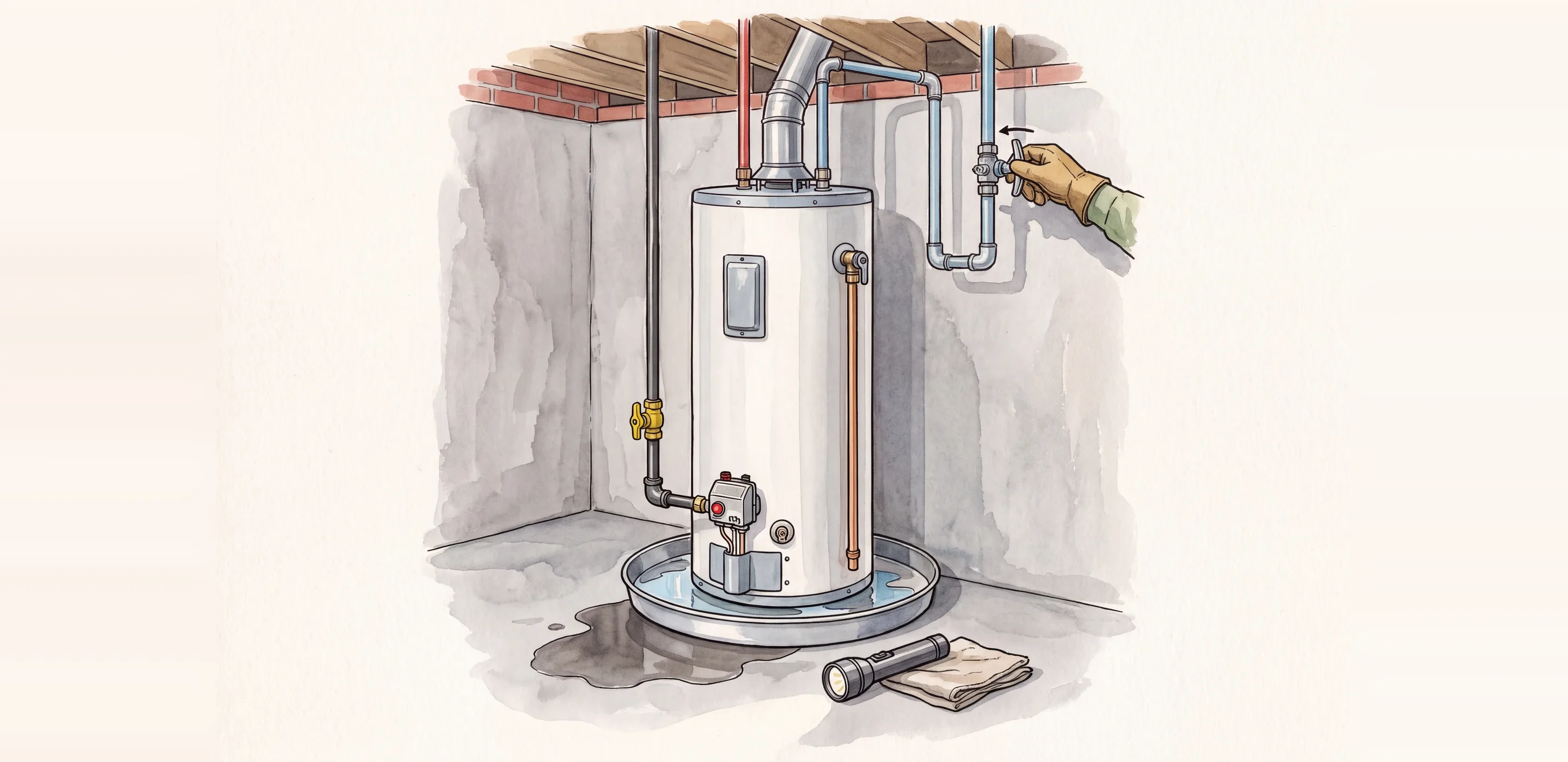
Do this first
Four steps, in this order
Close the valve on the heater’s own supply pipe. The state plumbing code requires a shutoff on the water supply pipe to every water heater, so there should be one on the cold water pipe that feeds the heater (the state plumbing code).
If that will not hold it, close the main shutoff. The water department’s own advice to every Detroit homeowner is to find your main water shutoff valve inside the house and label it, so that you can turn the water off quickly when something bursts (DWSD).
Turn off the heat. On a gas heater, turn the gas control on the tank to off. On an electric one, switch off its breaker.
Call us. Your details go to one water heater contractor who serves Detroit. Ask what it will cost to look at it, and ask for the price in writing before any work starts.
Not the water department’s emergency line
DWSD prints 313‑267‑8000 for reporting a water or sewer emergency, and it is the right number for a water main break or a problem in the street (DWSD).
It is not the number for a leaking tank. DWSD’s own ownership sentence draws the line at the curb stop: DWSD maintains the mains and the service lines up to the curbstop, and the property owner is responsible for the water service line from the curbstop to inside the home or business and the internal plumbing inside the house (DWSD). A water heater is inside the house, so it is yours, and it is a contractor’s call.
Two different leaks
Water from the pipe is the valve working. Water from the tank is the tank.
From the discharge pipe
Every water heater has a temperature and pressure relief valve with a pipe running down from it. The state code says that pipe must end not more than 4 inches from the floor with an unthreaded end, and must discharge to the floor, to the pan under the heater, or to a waste receptor — never straight into the drain system (the state plumbing code).
Water coming out of that pipe is the valve doing its job. The manufacturer’s reading: a relief valve will drip if the water pressure is too high, or from thermal expansion on a closed system — control the pressure and fit an expansion tank before anyone replaces a dripping valve (A. O. Smith).
From the tank itself
Water seeping from a seam, from under the jacket, or pooling under the base with the fittings dry is the tank itself.
HomeGuide says a leaking tank typically means replacing the heater, and puts that at $600 – $1,800 nationally (HomeGuide). Repair or replace.
Wipe the pipe and the tank dry and look again with a flashlight. It is the difference between a part and a whole new heater.
How long a tank lasts, and why Detroit’s water matters
The federal energy office’s guide puts storage water heaters at 10–15 years and tankless units at more than 20 (the guide).
What shortens the tank end of that is sediment, and sediment is a hard water problem. The water department’s own 2025 mineral table puts Detroit tap water at 107 ppm total hardness on average, 96 at its softest and 142 at its hardest (the 2025 report). On the federal water survey’s scale, 61–120 is moderately hard and 121–180 is hard (the survey), so the average sits in the moderate band and the worst sample in the hard one.
The manufacturers say what to do about it. A. O. Smith: most tank heaters need flushing at least once a year, and if you live in a hard water area you may need to flush more often (A. O. Smith). Rheem: once a year, and every 6 months with hard water (Rheem). DTE says the same in one line — flushing annually removes the sediment that builds up (DTE). Published national cost of a flush: $75 – $250 (HomeGuide).